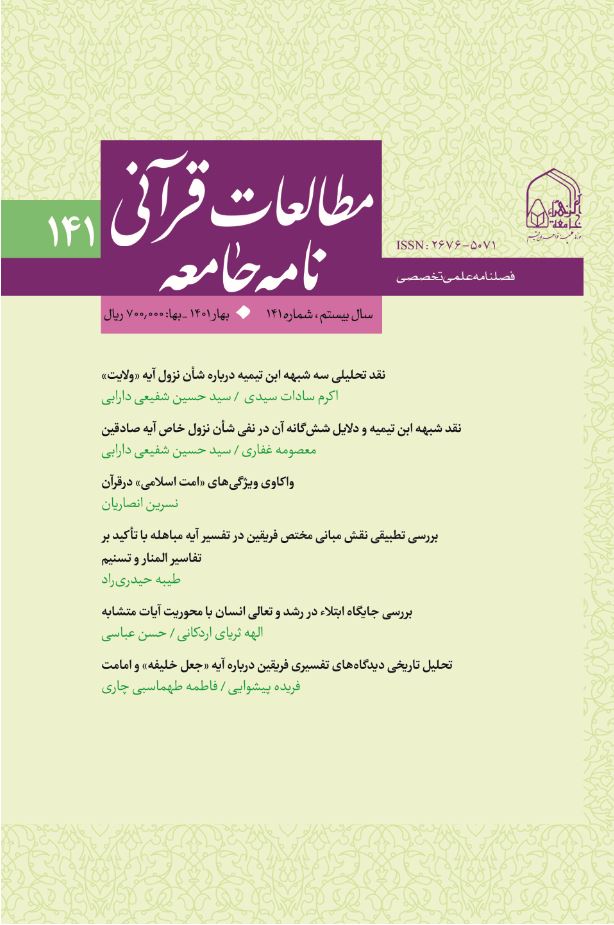
نوع مقاله : مقاله پژوهشی
An Analytical Criticism of Ibn Taymiyyah's Three Dubieties
Regarding the Cause of Revelation of the "Wilāyah" Verse
Akram Sadat Seyyedi[1]
Seyyed Hossein Shafiei Darabi[2]
1]. Level 4 (PhD) Graduate of Comparative Interpretation from Jami'at al-Zahra, Qom, Iran; akramsadat.seyedi@yahoo.com
[2]. Professor at High Levels of Qom Seminary, PhD in Qur'anic Sciences and Interpretation, Faculty Member and Assistant Professor of Al-Mustafa International University, Director of the Department of Qur'anic Sciences and Interpretation at Jami'at al-Zahra, Qom, Iran; Shafieidarabi@chmail.ir
Abstract
One of the most significant verses cited by Shi’a scholars in order to prove the Imamate of Hazrat Ali (AS) is known as the "Wilāyah" verse. Ibn Taymiyyah, by raising several dubieties, has attempted to undermine and deny the indication of this verse. Among the dubieties raised by this renowned Sunni figure, are those regarding the cause of revelation of the verse and its disconnection with the Imamate of Imam Ali (AS). This study which was carried out using the descriptive-analytical method and library sources), an analytical critique of these dubieties is presented. The findings of the research indicated that Ibn Taymiyyah was the first to explicitly deny the revelation of the "Wilāyah" verse for the purpose of proving the Imamate of Imam Ali (AS) and to claim consensus on its denial. In view of the fact that a group of Sunni scholars such as al-Ṭabarī, Ibn Abī Ḥātim al-Rāzī, al-Baghawī, etc. (who are trusted by Ibn Taymiyyah), have confirmed the verity of the above-mentioned cause of revelation, the falsity and the contrariness of Ibn Taymiyyah's stance towards the cause of revelation of the "Wilāyah" verse to Fariqain’s consensus is an indisputable fact. Furthermore, the multiplicity of the narratives indicating the verity of this cause of revelation and the reference made by a number of jurists to them in some of the jurisprudential opinions reveal their validity and authenticity.
Key words: the "Wilāyah" verse, the cause of revelation of the verse of Wilayat, Ibn Taymiyyah's dubieties regarding the cause of revelation of the "Wilāyah" verse, contradictory responses to Ibn Taymiyyah's dubiety, solving solutions to Ibn Taymiyyah's dubiety.